Recent comments in /f/history
bradnelson t1_j1iscou wrote
Reply to comment by Type31971 in Simple/Short/Silly History Questions Saturday! by AutoModerator
This, and by the 1930s mass media made it possible to disseminate propaganda to a wide audience. Photography, film, and radio were powerful.
mobilgroma t1_j1isbia wrote
Reply to comment by bradnelson in Simple/Short/Silly History Questions Saturday! by AutoModerator
Thanks for the quick and very good reply!
And because they do different things than the main army, they are organised and named differently?
Devil-sAdvocate t1_j1is0wg wrote
Reply to comment by Welshhoppo in How did the Romans manage to arm most of their soldiers with swords? by Horror_in_Vacuum
> Plus you could pick them up after the battle and get someone to reforge them back into shape.
Swords from dead or retired soldiers could be reused as well, meaning they didn't need to make a new sword for every new soldier that ever joined.
bradnelson t1_j1irub0 wrote
Reply to comment by mobilgroma in Simple/Short/Silly History Questions Saturday! by AutoModerator
Sending a smaller unit out ahead of the main body is primarily done to locate the enemy and scout positions. A smaller unit is more mobile and can fall back to the main body. Sometimes you want your enemy to chase the vanguard as it retreats so that your main force can then attack the enemy from favorable ground. Very commons in Napoleonic and American Civil War era tactics, though you still see good examples of it in the world wars.
en43rs t1_j1irist wrote
Reply to comment by smoakee in Simple/Short/Silly History Questions Saturday! by AutoModerator
First, it not that difficult to think of piling rocks, that's why it's common.
Then, northern civilisations: of course there is nothing in Antarctica and the Arctic... there are no human civilisations in the Antarctic and humans living in the Arctic usually do not build permanent structure.
As for northern civilizations... it's tricky. Building a monument like this supposes a complex society (a powerful and rich government) that is able to build large structures: so you find some in China for example (it's not that complicated to pile rock). Not really in Europe and North American because before the Middle Ages they didn't have the wealth, when they did (by late Antiquity), it just wasn't the style anymore).
What you find a lot in those places is earth pyramids, tumulus. So yeah they kinda build those.
mobilgroma t1_j1iqw6i wrote
Why did armies have a vanguard? Why is it separately named to the rest of the army and not just a part of it?
en43rs t1_j1iqd9f wrote
Reply to comment by annatheorc in Simple/Short/Silly History Questions Saturday! by AutoModerator
Because witches are based on medieval antisemitic stereotypes: in medieval art Jews are sometimes represented with big noses and pointy hat. The hats are loosely based on a hat some Jews wore in some areas.

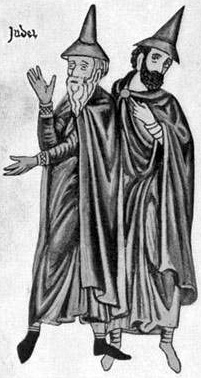
After expelling the Jews from their lands European Christians started using their antisemitic stereotypes on a new marginalized enemy: the "witches". It wasn't intentional to be clear, it's was basically just "that's what bad people look like".
Interesting facts: Spain expelled their Jews way later than the rest of Europe (1492 compared to the 1200s-1300s in other places) and there weren't that many witch hunts in Spain (but a lot of paranoia about "secret Jews")
[deleted] t1_j1iq8cl wrote
Reply to comment by Thibaudborny in Simple/Short/Silly History Questions Saturday! by AutoModerator
[removed]
joeri1505 t1_j1ips2v wrote
Reply to comment by Lord0fHats in Simple/Short/Silly History Questions Saturday! by AutoModerator
Yeah i somewhat know that theory and it makes sense But you have to see how much has to go right in that process.
The pottery clay just happens to contain metals. That's just luck. The metals melt at a low temperature, luck People figure out how to recognize metal ores Refining ore Building kilns that can get hot enough Adding carbon to make steel from iron.
Its similar to how the Chinese just never really figured out how to make clear glass. Causing them to never develop glasses
Type31971 t1_j1ipg5k wrote
Reply to comment by Lord0fHats in Simple/Short/Silly History Questions Saturday! by AutoModerator
This has already been gone over…
[deleted] t1_j1ipfqg wrote
Reply to comment by Dutchie-4-ever in Simple/Short/Silly History Questions Saturday! by AutoModerator
[removed]
Lord0fHats t1_j1ip5xp wrote
Reply to comment by Type31971 in Simple/Short/Silly History Questions Saturday! by AutoModerator
We’ve found toys in west Mexico that are wheeled. They at some point at least did figure it out. As for why it never caught on, common guesses are a lack of draft animals, rough terrain, and more availability of navigable waterways.
Also the possibility that what was being traded didn’t incentivize heavy loads. Most cultures in the Americas were self-sufficient for food. Their currency wasn’t based in valuable metals. Most trade was focused on finished goods and wares, not bulk raw materials.
Lord0fHats t1_j1ioprt wrote
Reply to comment by joeri1505 in Simple/Short/Silly History Questions Saturday! by AutoModerator
I’ll look for it but there’s a fantastic post right here on reddit explaining how pottery leads to metal working in a very simple and logical progression.
TLDR; pottery processes can produce copper slag. Once people started using that they just gained more knowledge about metal.
Lord0fHats t1_j1iobk8 wrote
Reply to comment by Deep-Site-8326 in Simple/Short/Silly History Questions Saturday! by AutoModerator
It’s a two fold question.
First; the neighboring Tarascan civilization had metal working. In all of meso-American the western side of Mexico is the only part where we find metallurgy being practiced locally. They likely imported this know from South America at some point.
It had been present in West Mexico for more than a thousand years. So, why didn’t the rest of Meso-America adopt it?
We don’t know but we can make some logical guesses.
The first is that there were no known sources of copper. Early metal working derived as a result of pottery. The process of glazing and finishing pottery can produce copper slag. So its an easy progression that pottery leads to metalworking.
Problem is that there isn’t a lot of copper to be found in the soil or pottery styles of the region so they never made the leap.
But they were adjacent to metal workers for centuries. The Aztec were even at war with the Tarascans.
And they weren’t losing.
So here we come to obsidian. Obsidian is a useful rock. Its brittle but it can hold a very sharp edge. It’ll break sure… but so what? Just get more obsidian and make a new edge.
We see a similar pattern int he near east. There were groups slow to adopt metal tools because stone tools are simple. You didn’t need an artisan to make or fix them. They’re cheaper. Anyone can make a basic stone tool.
And that’s probably why the Aztecs didn’t switch to bronze. Obsidian’s general ease of use and practicality was more valuable to them. They didn’t see the advantages si they didn’t adopt copper. Don’t adopt copper you don’t get bronze. Iron takes more skill to work and experience working iron leads to steel.
This is a fairly consistent global pattern but it was stalled in Meso-American by a lack of metal sources and the many uses and ease of use of obsidian.
getBusyChild t1_j1inyjp wrote
Merry Chrstmas!
Now on to the question. Is there any evidence that Werner Heisenberg intentionally delayed or even sabotaged the German atomic bomb project? Seeing how news of Hiroshima it only took him a couple of minutes to figure out how the US/Allies did it, but he could not in 6-7 years under the Nazi's?
CrocoMaes t1_j1imzu1 wrote
Reply to comment by MewMimo in Simple/Short/Silly History Questions Saturday! by AutoModerator
He came about at the perfect time: long ago enough that we can compare him to other historical figures like Nero or Torquemada without falling into cultural bias (unlike for instance with Richard Nixon or even Donald Trump). His reign having ended completely long enough not to have any influence on the current world (unlike for instance Mao or Stalin) yet still no so long ago as there are still people around remembering him and his reign (unlike for instance Ghengis Khan)
smurf_professional t1_j1im4s9 wrote
Reply to comment by mouse_8b in Simple/Short/Silly History Questions Saturday! by AutoModerator
Rudolf I of Habsburg, the first King of Germany, also sporting a prominent nose.
Lord0fHats t1_j1im26b wrote
Reply to comment by Norumbega-GameMaster in Simple/Short/Silly History Questions Saturday! by AutoModerator
We sort of can but it involves guessing.
BobbaFett2906 t1_j1ilqia wrote
How long is the movie Triumph of the Will? I'm trying to educate myself on the rise of the Nazis and the events leading to the Holocaust and I decided I wanted to see Triumph of the Will (1935), but I encountered a problem. Wikipedia, and many other sources, say the movie is 114 minutes old. However, all of the versions I could find online of the movie are only 104 minutes old. What are the other 10 minutes? Thanks in advance.
annatheorc t1_j1iljqd wrote
Why did depictions of witches have pointy hats? Is that a new portrayal or were they always shown to wear pointed hats?
Type31971 t1_j1ilibh wrote
Reply to comment by anarchysquid in Simple/Short/Silly History Questions Saturday! by AutoModerator
The Americas were hit and miss. They pioneered the zero in mathematics while large swaths were no farther advanced than the Stone Age when Europeans showed up on their doorstep. Saying they lacked inventiveness is a stretch, but at the same time having access to the wheel but not taking this basic technology to its logical conclusion is maddening
Skookum_J t1_j1ijr5k wrote
Reply to comment by Aggressive-Ad5292 in Simple/Short/Silly History Questions Saturday! by AutoModerator
Balsa Wood rafts were used for trade along the Pacific coast from Peru to Mexico. The rafts were not too complex, but they were rigged with sails, could be 30 feet long, and cary 20-30 tons of cargo.
smoakee t1_j1ii1ih wrote
The pyramids were built all over the world by seemingly unconnected civilisations like Inkas, Egyptians, or by asian civilisations.
My question is: Are there any northern civilisations who built them as well?
I once saw an art of a pyramid covered in snow and ice and … it just stuck with me so hard. Been researching Arctica and Antarctica for any archelogical sites/evidence of something like this, but without success, all of it are hoaxes or conspiracies :/
anarchysquid t1_j1ig4hu wrote
Reply to comment by LateInTheAfternoon in Simple/Short/Silly History Questions Saturday! by AutoModerator
what's your alternative theory?
annatheorc t1_j1itf4f wrote
Reply to comment by en43rs in Simple/Short/Silly History Questions Saturday! by AutoModerator
Thank you for explaining! That's terrible. Do you know what the marginalized group called witches was? Where they people the group decided to hate or were they their own distinct group with their own culture? We're witches a gendered group like they're mostly seen as today?