Recent comments in /f/askscience
[deleted] t1_j8rlrx5 wrote
nicemike40 t1_j8rlcng wrote
[deleted] t1_j8rjpwb wrote
Reply to comment by Movpasd in When measuring the wavelength of EM radiation... what's actually being measured? by Grand-Tension8668
[removed]
Stephanie87-123 t1_j8rhbfd wrote
Reply to comment by TrenchantPergola in Recently a gene therapy for a rare inherited neurodegenerative disorder was approved. How come cure is achieved through bone marrow transplantation? by nickoskal024
The disease is not caused by ARSA deficiency in leukocytes specifically though, but rather by ARSA deficiency in all cells that lead to sulfatide accumulation that is more toxic for specific organs/cell types, like the brain and the galbladder. The bone marrow transplantations works because the blood derived cells will migrate into the brain and breakdown the excessive sulfatides in the extracellular space.
CrustalTrudger t1_j8rgaeh wrote
First we need to consider the Hawaiian Islands in their full context, i.e., the Hawaii-Emperor Seamount Chain, which are all generated from the same hotspot. To make sure we're all on the same page, yes, the general idea is that the hotspot is semi-fixed with respect to the moving plates (reality is a bit more ugly, e.g., this FAQ - but for our purposes we can say the hotspot is effectively fixed). As such there is hotspot volcanism in the location above the hotspot for a time - which if the hotspot is erupting through an oceanic section of a plate and magma production is sufficient, will tend to produce an island - until this spot on the plate is advected away sufficiently by plate motion to generate a new eruptive center, eventually forming a new island (again, reality is a bit more complicated in terms of how connection between a soon-to-be-dead and new eruptive centers are severed and established, again, covered in one of our FAQs). For kind of schematic representation, consider this image from the National Park Service.
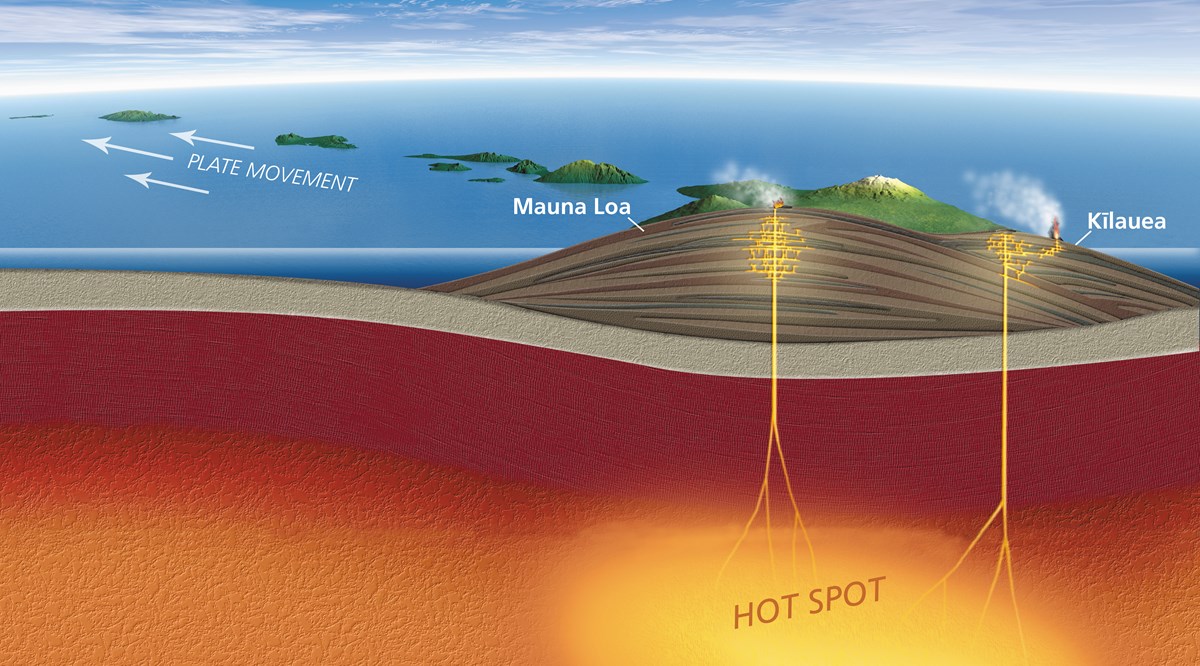
For the Hawaii-Emperor chain, if we look along this full hotspot trend, we'll see a general pattern of increasing size and elevation going from the oldest end (i.e., the bit that is actively being subducted at the Kuril Trench) to the youngest end (i.e., the Hawaiian islands). The reasons for this progressive increase in size are three fold:
- Subsidence. This is probably the largest effect, but the relative contribution between it and the next driver are a bit hard to partition out. In short, in addition to the volcanism, there are two things that are happening in the section of oceanic lithosphere directly above the plume, it's getting hotter AND it's physically being pushed up by the warmer, more buoyant section of the mantle that is the plume itself. For the first, generally warmer lithosphere is less dense and through isostasy tends to have higher average elevation (this, for example, is why depth of portions of the oceanic basins are largely tied to lithospheric age since for areas not influenced by a hotspot, age is a proxy for temperature as sections lose heat as they move away from mid-ocean ridges). For the second, the plume in the mantle generates a "swell", i.e., a dome like uplift centered on the plume, which would fall under the umbrella of dynamic topography. As an oceanic island is advected away from the plume, it will subside (i.e., sink) both through thermal relaxation (i.e., it and the surrounding lithosphere will get colder and more dense) and from moving off the swell under the plume. This means you generally expect oceanic islands to decrease in elevation and thus reduce in size at the surface (until they completely sink, becoming seamounts, guyots, etc.). Recent work would suggest of these two forces, subsidence related to moving off the swell is the dominant one (e.g., Huppert et al., 2020).
- Magma supply. The productivity of a plume, both in terms of melt generated but also the amount of melt that successfully erupts and contributes to the volume of oceanic island in question, is not necessarily constant. In the case of the Hawaii-Emperor chain, considering its longterm magma supply rate (e.g., Figure 2 from Poland et al., 2014) suggests that broadly the time in which the modern Hawaiian chain was forming (e.g., the last ~5 million years) represents a period of heightened productivity. Specifically for the big island, we can see that some estimates (e.g., the Vidal and Bonneville one) suggest that the modern productivity is significantly higher than anytime in the past.
- Erosion. While not a dominant factor generally (at least compared to either subsidence or supply), while an oceanic hotspot island is above the plume and actively erupting frequently, the topographic expression of the plume reflects a balance between material added via volcanism and material removed by erosion (along with the isostatic and dynamic effects discussed in point 1). Once the volcanic system is shut off, the edifice will be degraded by erosion with effectively no processes to balance it out. Erosion will come in the form of river and hillslope processes, wave action, and mass wasting. The last can be significant for oceanic hotspot islands as they are prone to large "mega-landslides" (e.g., Holcomb & Searle, 1991, Oehler et al., 2008, etc). The Hawaiian islands are no exception and in fact a significant portion of O'ahu broke off ~1 million years ago and is visible in the bathymetry (i.e., the Nuʻuanu Slide). Broadly, once an island has been submerged through the combined action of subsidence and erosion, most of the erosional processes will stop (whereas the subsidence processes will continue).
Taken together, even without the Hawaii-Emperor specific bit of a general trend in increasing eruption rates, with just the patterns in subsidence and erosion, you would broadly expect that the most recent main eruptive center within an oceanic hotspot track to usually be the largest. Adding in the trend toward greater eruptive volumes through time that we see in the Hawaii-Emperor chain further reinforces this pattern. However, we always have to consider that we're looking at snapshots of a dynamic system. For example, the big island is the youngest subaerial part of the Hawaii-Emperor system (and also the largest), but it's not the youngest part of the system as a whole. A new seamount (and likely eventually a new island) has been forming for the last ~400,000 years to the southeast of the big island, i.e., Kamaʻehuakanaloa. The subsequent evolution of the system, e.g., when will Kamaʻehuakanaloa eclipse the big island in terms of size, is hard to predict since projecting out the eruption rates and accounting for things like mega landslides are challenging.
_mizzar t1_j8r9mfl wrote
Reply to comment by Aseyhe in How are we able to observe the early universe? by four-lima-golf
The above comment is the best answer because it focuses on your primary misunderstanding which is that the past we are seeing into is not the past of “our part” of the universe.
The universe is likely infinite. The observable universe is a sphere with us in the middle. The edge of the sphere is where we see the oldest parts of the universe because the light from these distant places is just now reaching us, showing us what things looked like back then.
This sphere is getting bigger for an obvious reason, more and more light from distant places is reaching us. However, the sphere is also getting bigger because the entire universe (not just the observable universe sphere) is expanding.
Careful here not to imagine the entire universe’s expansion as a sphere, but rather every galaxy that isn’t locally bound to another galaxy by gravity is moving away from one another.
An oversimplified way to imagine this is to visualize an infinite 3D space with tennis balls each 10 meters from one another in every direction. Move forward through time and as the universe expands they are now 20 meters away from one another. Move back in time and they are 5 meters away from one another and so on.
The interesting thing is that, though the speed of light is constant, this expansion of the entire universe seems to happen faster with the more space that there is between things, as if the space itself was causing the expansion (we call this mysterious force Dark Energy).
What this means is that eventually the expansion of the entire universe will outpace the speed of light, making galaxies we can currently see in the observable universe fade out of sight as they slip out of our observable universe. Eventually, only our own galaxy (at this point merged with Andromeda) will visible to us, everything else too far away and the universe expanding too fast for new light to reach us.
If humans still exist in this time, they would have no knowledge of other galaxies and the universe unless we managed to pass down the data from our time.
[deleted] t1_j8r4k60 wrote
Savings_Wedding_4233 t1_j8r26k8 wrote
Movpasd t1_j8qxs6w wrote
Reply to comment by wooly_boy in When measuring the wavelength of EM radiation... what's actually being measured? by Grand-Tension8668
It's quite complicated, but I'll try to give a brief answer --
Maxwellian electrodynamics is a classical field theory. When you canonically quantise such a theory, you find that a (sort of*) conserved, discrete quantity pops out, which can be interpreted as "particle number".
This is in line with observations from a century back around black-body radiation that appeared to show quantisation of energy levels.
It's also a satisfying interpretation because certain calculations in QFT have combinatorial properties which allow them to be represented using Feynman diagrams (which you've probably heard of). Together with the path integral formulation, you get a really useful picture of the physics of scattering. But this is mired in complications (renormalisation, confinement (not a problem for photons but it is for quarks), divergences around every corner, ...).
As a side note, instead of starting from the field theory, you can build up a quantum field theory by starting from a particle-based theory; a common approach for effective theories in condensed matter theory, because it's much more tractable mathematically. The fact that QFT unifies classical many-particle and field theories is an advanced form of the "wave-particle duality" you might have heard of.
*: conserved in the free theory
itsallrighthere t1_j8qxnze wrote
Reply to comment by Stephanie87-123 in Recently a gene therapy for a rare inherited neurodegenerative disorder was approved. How come cure is achieved through bone marrow transplantation? by nickoskal024
Thanks, we do live in interesting times.
Stephanie87-123 t1_j8qwtfn wrote
Reply to comment by itsallrighthere in Recently a gene therapy for a rare inherited neurodegenerative disorder was approved. How come cure is achieved through bone marrow transplantation? by nickoskal024
It really depends on the specific disease and the mechanisms that causes damage to brain cells, but in some cases yes. For most of those disease the toxic compounds will be secreted from the cells, so they are in the extracellular space were the modified cells can take them up and process them.
Gene therapy is not my area of expertise, so someone else might be more up to date on this. The major risk of gene therapy is that the insertion/editing of a gene will lead to unintended disruption of other genes, which worse case scenario might make them more likely to become cancerous. The method used for this treatment, ex vivo gene therapy, were the gene therapy is performed outside of the body is more safe as it allows for extra checks on the cells before they are transplanted back into the patient.
Movpasd t1_j8qwacc wrote
Reply to comment by JTech324 in When measuring the wavelength of EM radiation... what's actually being measured? by Grand-Tension8668
I'm glad you liked my comment! I do have a blog, which I'll link here (assuming there aren't any rules against it -- I can take down my comment otherwise). It's pretty empty at the moment though. I've meant to put down all my thoughts about physics and intuition in one place at some point, but I just haven't gotten around to it. If you liked it, maybe there is an audience for it!
Movpasd t1_j8qvfax wrote
Reply to comment by Grand-Tension8668 in When measuring the wavelength of EM radiation... what's actually being measured? by Grand-Tension8668
I'm very glad you found my reply useful!
If you're set on continuing to teach yourself physics (which I think is a very good, though time-consuming idea), I'd start by making sure you're on top of your high school/A-Level maths and physics (KhanAcademy is a great place for this), and then move onto some first-year university introductory textbooks. You don't have to read them back to front -- start with the first chapter, take your time, do the exercises, and when you get bored switch to a different book. (I really like Griffiths' textbooks, but YMMV.)
A good search term is "introduction to [topic]" or "introductory [topic] textbooks". Good topics to start with would be classical mechanics, electrodynamics, and quantum mechanics. You could then move onto special relativity and statistical physics (my favourite!).
juansinmiedo t1_j8qvb4q wrote
Reply to comment by Chemomechanics in Does refracting light impart momentum onto the object that is refracting it, for the duration of the refraction? by TheFeshy
Does it mean that the reflected (or refracted) photon has a longer frequency (less energy)?
[deleted] OP t1_j8qtxyd wrote
Reply to comment by [deleted] in Why do some surfactants lather while others don't? by [deleted]
[removed]
Megalomania192 t1_j8qqyqr wrote
Sadly the current top answer is quite wrong.
Foaming behaviour and micelle formation are not linked in any meaningful way. I won't address why, I'll just answer your question, by rephrasing it just a tiny bit:
>Why do some surfactants form stable foams while others don't?
Because if you blow air through a suitably concentrated solution of almost every surfactant you can generate 'bubbles'. The question is really whether or not they are stable.
The stability of a foam depends on the interfacial tension of the hydrophobic/air interface and on the ability of the hydrophilic side to trap water.
The foam is basically air/detergent/water/detergent/air. They are quite similar to lamellar sheets that many detergents form, which are water/detergent/detergent/water. I don't know if forming lamellar phases in solution is a predictor of forming stable foams or not.
If the interfacial tension is low, the bubbles are extremely metastable, they'll pop and merge and generally fall apart fairly quickly. Conceptually the interfacial tension (if you can hold everything else constant) is covarient with how densely the hydrophobic tails pack, like if you could make a model system where you could arbitrarily vary the density of the hydrophobic bit, the denser one would also have higher interfacial tension.
But this can lead you to the false conclusion that less curved foams must be more stable, which is indeed a false conclusion. Because of course it's actually a free energy property so there's a series of enthalpic and entropic terms to consider.
If the hydrophilic side can't trap water sufficiently well then they will 'drain'. That is to say, the water in the detergent sandwich will be pulled back by gravity into the bulk solution.
The size of the air bubble in the foam is determined by the aspect ratio of the detergent which is not particularly correlated with either of the other two properties (this is why I included the spurious conclusion about less curved foams being more stable) and the initial size of the bubble is also affected by how you prepare the foam which is a confounding variable.
There are additives you can add to detergents to stabilize or destabilize a foam.
[deleted] t1_j8qolxp wrote
Reply to comment by KillerCodeMonky in Light traveling through a medium that slows it. Does the same photon emerge? by TheGandPTurtle
[removed]
[deleted] t1_j8qofar wrote
[removed]
GooseMuckle t1_j8qn81o wrote
Reply to Does refracting light impart momentum onto the object that is refracting it, for the duration of the refraction? by TheFeshy
Yes! This effect is used for laser cooling. The momentum from a photon can be imparted to an atom; if done in the right way a cloud of atoms can be cooled to a few billionths of a degree above absolute zero. One cool application of this technology is optical clocks, which form the most precise clocks in existence.
Chemomechanics t1_j8qimev wrote
Reply to Does refracting light impart momentum onto the object that is refracting it, for the duration of the refraction? by TheFeshy
I did a PhD involving this. Yes, light passing from one medium to another gives the interface a momentum kick. (Edit: example video, not mine.)
DreamerOfRain t1_j8qi4t7 wrote
Reply to comment by SvenTropics in Is it true the humans could breathe and live in the atmosphere of Venus? by Impossible_Mine_1616
Yeah but you can already easily extract a lot of useful things from the dense atmosphere like carbon, nitrogen, sulfur that is useful in agriculture to sustain population.
Also, the surface environment is hellish, but it can be withstand with more robust engineering that are designed to withstand heat and pressure like from deep sea and deep earth environment compare to lightweight probes full of sensitive electronics. For example mechanical tethers and drill could be dropped from baloon high above to anchor and extract resources. It will be a monumental feat of engineering, but nothing that would be impossible to overcome with near future technology.
Perhaps the biggest problem with Venus colonisation is that it might not be viable economically. Compare to the readily available Helium -3 on the moon or the vast amount of ore and other resources on Mars that are easily accessible on the surface, Venus don't have much that is going to excite investors to dump trillions upon trillions on it. Maybe if we were able to discover something really interesting there, like remnant of a civilization or something, then there would be interest. Otherwise it will probably be at most a research base to utilize the venus environment to test technology.
hatsune_aru t1_j8qgjmj wrote
Reply to comment by imreolajossr in How does rubbing or hitting two metal objects together create radio waves? by hondata001
the bottom drill bit is rolling around in the velvet, that's likely picking up charge.
chickenologist t1_j8qg16w wrote
Reply to comment by bbob_robb in Why do dopamine reuptake inhibitors not treat Parkinson's disease? by unripenedboyparts
That's the hope. Similar but different is delaying with l-dopa that makes dopamine production easier. Same idea. Turn up the gain on a fading signal.
Onetap1 t1_j8rly4g wrote
Reply to comment by Highjumper21 in What do bacteria living in mechanical ventilation feed on ? by malahchi
It was a tragic irony that they'd survived WW1, WW2, Korea, Vietnam and/or whatever else, only to be killed by contaminated water droplets in the USA.