Recent comments in /f/askscience
PapercuttingTheHell t1_j8j7mri wrote
Reply to When measuring the wavelength of EM radiation... what's actually being measured? by Grand-Tension8668
I could answer but it's primarly borig for anyone else that electricians and electrical and electronical engineer. So just to make it clear, there's no matter involved, only electric fields, which have magnetic properties if used as so. We call it waves because as soon as we want to illustrate them ; models will turn that in something that's most understandable in the form of waves. Flies off
bringmeadamnjuicebox t1_j8j6w9f wrote
Ventilators often run with a heated humidification system. The circuit will collect enough water that it has to be drained. Patients are coughing all sorts of gross crud into the tubing. The circuit also gets broken from time to time, as stuff gets soiled or clogged, parts need to get changed out. So there's often opportunity for bugs to get in there.
[deleted] t1_j8j6pdl wrote
Reply to comment by [deleted] in When measuring the wavelength of EM radiation... what's actually being measured? by Grand-Tension8668
[removed]
MasterPatricko t1_j8j6gkn wrote
Reply to comment by Weed_O_Whirler in Light traveling through a medium that slows it. Does the same photon emerge? by TheGandPTurtle
> according to General Relativity, a massless particle must always travel at c.
That's special relativity, not general relativity (yes, GR includes SR, but you get what I mean).
The fundamental wrong assumption people make is that a wavepacket of the EM field -- a photon -- in a vacuum is somehow "the same" as the wavepacket of the EM field in a complex background of charged particles, i.e. a real material made of atoms.
To make an analogy (of limited range, please don't abuse it :)): no-one is surprised that a classical gravity wave in water and a wave in honey behave differently. Why is it surprising for an EM wave? /u/Keudn 's description is classical and doesn't explain how to calculate the speed in a medium, but aside from that missing depth, strictly correct.
DamionFury t1_j8j6cgr wrote
Reply to comment by Parrek in Light traveling through a medium that slows it. Does the same photon emerge? by TheGandPTurtle
Ah yes. That's right. I also remember we talked about the case of permanent magnets and objects suspended above them. I don't remember what his answer was and I wouldn't be surprised if he told me to try to work it out for myself because my questions were holding the class up.
HopingMechanism OP t1_j8j5bqv wrote
Reply to comment by mikerowave in Why don’t we see multiple points of light for observable bodies as our planet and the observed body move over millennia, changing their position relative to each other? by HopingMechanism
That’s pretty wild. This is the type of stuff I’m talking about. Anyone coming across that without knowing better might assume it’s an active explosion.
xenneract t1_j8j579k wrote
Reply to comment by karantza in Light traveling through a medium that slows it. Does the same photon emerge? by TheGandPTurtle
> AB and BA are the same states
For bosons, fermions pick up a -1 on exchange
[deleted] t1_j8j4r79 wrote
Reply to Is it true the humans could breathe and live in the atmosphere of Venus? by Impossible_Mine_1616
[removed]
[deleted] t1_j8j4cmf wrote
Reply to comment by [deleted] in When measuring the wavelength of EM radiation... what's actually being measured? by Grand-Tension8668
[removed]
mikerowave t1_j8j4cet wrote
Reply to Why don’t we see multiple points of light for observable bodies as our planet and the observed body move over millennia, changing their position relative to each other? by HopingMechanism
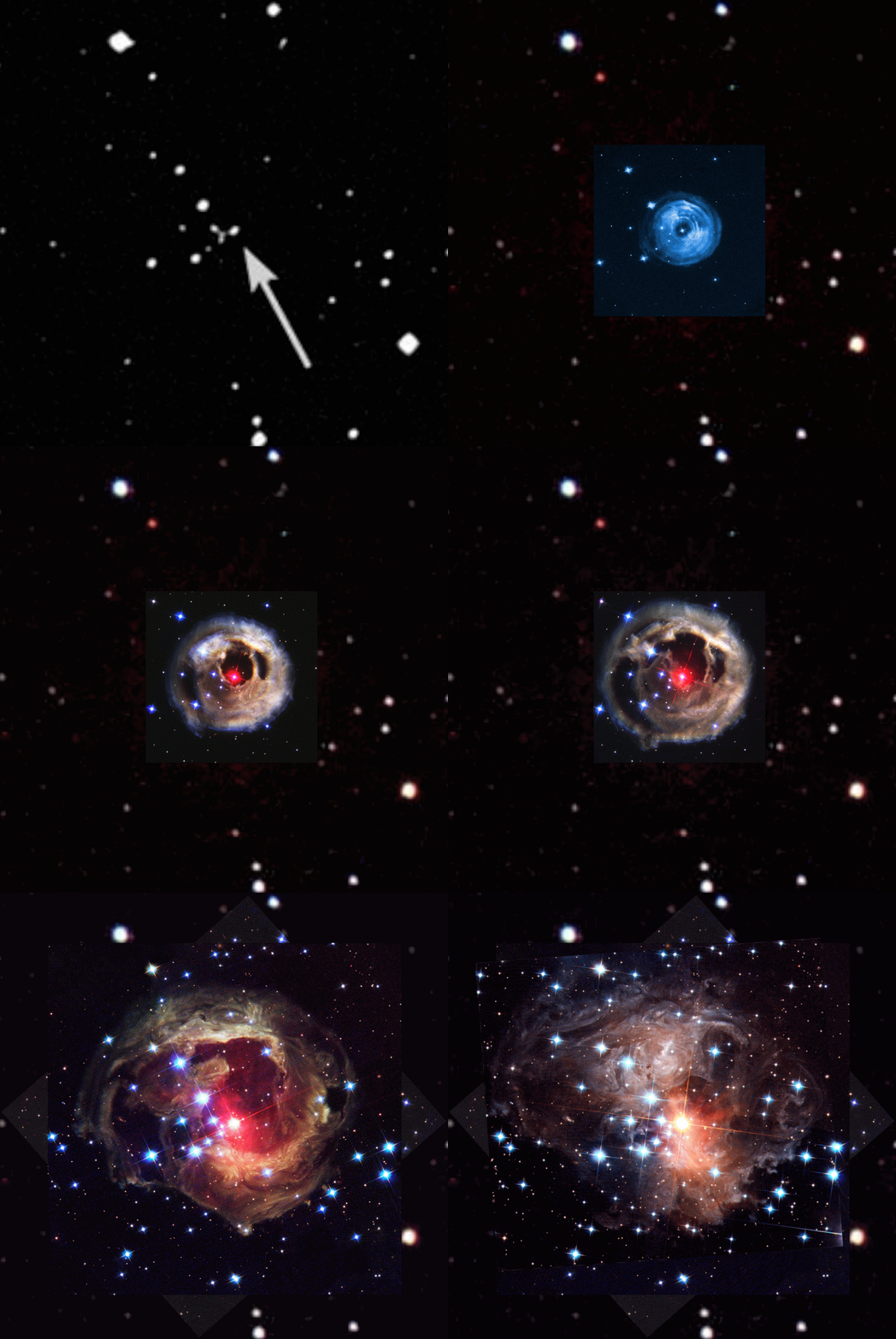
One interesting example of how the very fast but finite speed of light can change what we see when we look at an object over an extended period of time is the observed light echo in V838 Monocerotis system. In the video (which is composed of individual observations over a time base of 2 or 3 years), it looks like we are watching a shell of debris expand out away from the central pair of objects, but this is actually not the case. Rather, what we are seeing is light traveling outward and illuminating successively further layers of a pre-existing but invisible shell of material
[deleted] t1_j8j4bk6 wrote
Reply to comment by [deleted] in When measuring the wavelength of EM radiation... what's actually being measured? by Grand-Tension8668
[removed]
GeriatricHydralisk t1_j8j41wp wrote
Like everything in biology, there's one, unified answer: It depends.
Specifically, how do you define "exoskeleton"?
If you define it broadly enough to simply be a hard, outer layer, then basically everything with armor fits the bill: turtles, armadillos, oysters, etc. Even a variety of protists like diatoms.
If you say it has to support body weight, it gets more tricky, but there a few examples that squeeze in here: turtles again, crocodiles have specialized muscles to "brace" against their armored hide when walking, etc.
If you specify that it has to be involved in turning muscle shortening into body motion, like in arthropods and with our endoskeleton, nematodes may fit the bill, as they have a collagenous "cuticle" which inertnal muscles attach to. But it's not truly "rigid" the way an arthropod exoskeleton is (think of it like stiff rubber).
[deleted] t1_j8j3qju wrote
[removed]
[deleted] t1_j8j3oup wrote
Reply to comment by taphead739 in Light traveling through a medium that slows it. Does the same photon emerge? by TheGandPTurtle
[deleted]
[deleted] t1_j8j3m5p wrote
Reply to comment by [deleted] in When measuring the wavelength of EM radiation... what's actually being measured? by Grand-Tension8668
[removed]
MasterPatricko t1_j8j3fc4 wrote
Reply to comment by WagonWheelsRX8 in Light traveling through a medium that slows it. Does the same photon emerge? by TheGandPTurtle
I think you're on the right track, mostly. I can try to add some detail/clarification.
> 1) you emitted a single photon, there is a high probability that photon would be detected by the detector.
Yeah, more or less -- the probability depends on the coefficient of reflection of the surface of the glass. It could be high, or low, depending on the angle and refractive index of the glass, and will match the classical calculation of the relative amplitudes of transmitted and reflected waves (Fresnel equations), because fundamentally, the photon wavefunction is obeying pretty much the same wave propagation laws. Note you only get this behaviour if the photon wavefunction spatial extent (typically many photon wavelengths) means that it has the possibility to interact with many identical atoms which are spaced in a uniform way (relative to the wavelength of the photon). This is mostly true for optical wavelengths hitting normal materials (typical atom spacing 0.1nm, optical wavelength 500nm, any random variation is too small to be "seen" by a photon) but is not necessarily true at shorter wavelengths like X-rays, or if your "glass" is only a few atoms big. Those scenarios are more complicated and you don't always end up with the "normal" ray optics rules after summing those probabilities.
The only real difference to the classical wave picture is in the moment of detection -- instead of measuring a classical wave, with some part reflected and some transmitted, we are set up for a discrete, quantum mechanical interaction in the detector. A 1 or a 0. This collapses* the wavefunction according to the probabilities mentioned before, to either interact with the detector (and so we say the photon was transmitted and then absorbed in the detector) or not (and here we can say the photon was reflected).
> 2) ... However, because they are all part of a wavefront, none of them would be emitted out the sides of the transparent material?
You can hopefully see how the previous explanation scales up to emitting many photons, the numbers of photons detected will match the probability calculations. But to address your last sentence -- in this toy example, I assumed that there was no internal absorption or scattering inside the glass. In such a case, the original+scattered wavefunctions sum up such that the only possibilities are transmission straight through or reflection right at the interface, and there is no chance for a "random" photon to emerge out of the side of the glass at some angle. This isn't to do with photons being "part of a wavefront", unless I misunderstand you. More fundamentally, photons are waves; or at least, they travel in the same ways that classical waves do, and waves moving through a uniform medium don't just randomly scatter.
Now if we make things a bit more realistic -- the glass is not going to be a perfect crystal, and the uniform background of atoms assumption is not going to be exactly true. There will now be a small possibility of the wavefunction scattering differently off some imperfection in the atomic structure. Because it's associated with an imperfection, this part of the wavefunction won't be cancelled out by all the neighbouring scattered amplitudes, and you will end up with a real (but small) probability to have a photon emerging out of the side of the glass in some random direction, in addition to the main probabilities of transmission or reflection at the surfaces.
* "The measurement problem", or what exactly wave-function collapse really means physically, is a very thorny issue to which there isn't a good answer. But we know that mathematically, it works.
[deleted] t1_j8j3ave wrote
Reply to comment by [deleted] in When measuring the wavelength of EM radiation... what's actually being measured? by Grand-Tension8668
[removed]
drc500free t1_j8j35ct wrote
Reply to comment by ben_vito in Light traveling through a medium that slows it. Does the same photon emerge? by TheGandPTurtle
Think of the individual photons as different locations where a single universal wave function has high density, not as distinct particles. The idea that they are distinct only holds while those locations don't interact and interfere significantly.
Once they interact, the resulting waveform will have other regions of high density. Mapping one of them back to one of the original ones and saying this new photon is the "same" as that original photon is something that might make your brain understand it better by pretending they are Newtonian objects. But it's just a model for understanding, and the further the interaction is from Newtonian collisions the more wrong it will be.
[deleted] t1_j8j2xex wrote
Reply to comment by [deleted] in When measuring the wavelength of EM radiation... what's actually being measured? by Grand-Tension8668
[removed]
[deleted] t1_j8j2k0c wrote
Reply to comment by [deleted] in When measuring the wavelength of EM radiation... what's actually being measured? by Grand-Tension8668
[removed]
Parrek t1_j8j1x62 wrote
Reply to comment by DamionFury in Light traveling through a medium that slows it. Does the same photon emerge? by TheGandPTurtle
Usually the battery or another power source maintaining the magnetic field. Otherwise, the back current induced by the object being picked up would cancel everything out
Miss_ChanandelerBong t1_j8j1wh8 wrote
Reply to comment by unripenedboyparts in Why do dopamine reuptake inhibitors not treat Parkinson's disease? by unripenedboyparts
Like most things in science, the devil is in the details, and most people just don't have the expertise to parse those details out. Or, in many cases, the details aren't yet fully known. That's why it seems like there are contradictions, but, in reality, it's just different nuances.
[deleted] t1_j8j1rfq wrote
Reply to comment by [deleted] in When measuring the wavelength of EM radiation... what's actually being measured? by Grand-Tension8668
[removed]
common_sensei t1_j8j1l8a wrote
Reply to comment by skyler_on_the_moon in Light traveling through a medium that slows it. Does the same photon emerge? by TheGandPTurtle
Try it yourself!... although it probably won't work as described.
The wave would mostly regain the speed after the ping pong ball area, but it would be much reduced in height. A lot of energy would be lost to ripples going everywhere. My analogy just serves to illustrate the general concept of particles reacting to the approach and passing of the wave and generating interfering waves of their own.
However, a similar effect can be seen in wave tanks when you change the depth of the water: https://youtu.be/4_VejGC0DMM?t=261
In this case the interfering waves are bouncing from the new lower bottom of the tank, slowing down the wave.
MammothBobcat251 t1_j8j7u5n wrote
Reply to comment by PHealthy in If HIV is a retrovirus which embeds in the hosts DNA, why can a child be born without HIV if a parent has it? by scoobertsonville
Question. If the mother is vitally suppressed during pregnancy does that reduce the risk of vertical transmission or does the constant connection between mother and child in the womb counteract that process?
Great response btw.