Recent comments in /f/askscience
calgarywalker t1_j7qajs0 wrote
Reply to Are people with autoimmune diseases less likely to get viral infections? How about cancers? by Selfeducated
I have Celiac. There is such an increase in risk of some viral infections that the Pneumonia vaccines are recommended regardless of age (normally reserved for healthy people after age 65). Risk of some cancers is elevated - pancreatic, stomach, intestinal. Worse, some vaccines don’t seem to work as well (particularly Hep A in children). Heart disease is also elevated with an adjusted risk ratio of 1.27 after adjusting for other things like lifestyle choices (though no-one is sure why). Overall its about a 5 yr reduction in life expectancy - which is on par with other major immune diseases. And there is no medical treatment available. Only medical advice is to avoid a particular protein which is prevalent literally everywhere while there is evidence this strategy - even when done effectively - has limited success in managing symptoms. (Rather ironically, the one symptom most impacted by the GF diet is weight loss - people who actually need to eat GF tend to gain 10 to 20 lbs rather quickly. It is designed to be the exact opposite of a weight loss diet).
0b0101011001001011 t1_j7q8mtf wrote
Reply to comment by Automatic_Llama in Ask Anything Wednesday - Engineering, Mathematics, Computer Science by AutoModerator
In Finnish, no translation just a loan word: imaginaariluku (compound word, imaginaari luku)
LibertarianAtheist_ t1_j7q8buf wrote
Engineering: Jet engines on helicopters (or even small rc ones). How does the rotor "rotate" to make the heli turn; since its attached to the engine?
[deleted] t1_j7q70dp wrote
[deleted] t1_j7q1qai wrote
vmurphy5 t1_j7pz4lb wrote
Reply to What evidence is there for non-physical attributes being passed down from ancestors to their descendants through DNA? by PeanutSalsa
Most of the science surrounding inherited experience/knowledge is less about the DNA sequence itself and more about other factors, like how the DNA is expressed and the abundance of other cellular components like small RNAs.
Worms who's parents were exposed to a pathogen know to avoid that pathogen, despite never being exposed to the pathogen themselves. Worms who's parents did not have this experience do not know to avoid the pathogen. This is thought to be a result of small RNA based regulation of gene expression. https://www.cell.com/cell/fulltext/S0092-8674(19)30552-5?_returnURL=https%3A%2F%2Flinkinghub.elsevier.com%2Fretrieve%2Fpii%2FS0092867419305525%3Fshowall%3Dtrue
CrustalTrudger t1_j7pye07 wrote
Reply to comment by Endorkend in What would happen to a person standing on the edge of a faultline when it moves? by Endorkend
The interaction of seismic waves and the surface of the Earth can produce measurable pressure waves in the atmosphere (e.g., Donn & Posmentier, 1964), but generally nothing that's going to be damaging. This of course depends on what the fluid in contact with the solid earth surface is though as a tsunami effectively represents a displacement wave from surface deformation (from actual vertical change in the ocean bottom as opposed to seismic waves specifically), but here, it's not the pressure wave that's dangerous per se, but the resulting inundation when this approaches shore.
[deleted] t1_j7pwu82 wrote
Reply to comment by Straight-Plankton-15 in (Virology) Has SARS-CoV-2 outcompeted all the other coronaviruses which have been called the ‘common cold’? by jsgui
[removed]
Automatic_Llama t1_j7pw67l wrote
In languages besides English, what is the literal translation of that language's term for "imaginary number"?
Surely other languages have a less spooky term.
[deleted] t1_j7pv6jf wrote
[deleted] t1_j7pv63g wrote
[removed]
[deleted] t1_j7pt6n1 wrote
[deleted] t1_j7pqzxf wrote
Reply to What would happen to a person standing on the edge of a faultline when it moves? by Endorkend
[removed]
Endorkend OP t1_j7pqys6 wrote
Reply to comment by CrustalTrudger in What would happen to a person standing on the edge of a faultline when it moves? by Endorkend
So the shockwaves will almost purely go through earth then?
I've seen footage of volcanoes blowing where there is a visual airborne shockwave.
I guess it's because fault line movements are inside the earth and involve movement of obscene distances it gets spread better, but I thought that with the stupendous amount of energy released it would still have a decent effect above land too.
Thanks!
twiggsmcgee666 t1_j7pqubk wrote
Currently I am learning Norton's Theorem, Thevenin's Theorem, Kirchhoff's Laws, the Superposition Theorem, and the Law of Voltage Proportionality. All within the context of DC electrical circuit analysis. (Part of the licensed electrician journey)
Any tips and tricks for making these things easier to do when it comes to the drawing of the circuit and implementation of the theories?
[deleted] t1_j7ppvck wrote
Reply to comment by [deleted] in Does having autoimmune disorder (atopic disease in my mind, but also otherwise) lead to an increased risk of immune cell cancer? by MoBuckeye
[removed]
[deleted] t1_j7pnuei wrote
[removed]
[deleted] t1_j7plyy0 wrote
Reply to comment by [deleted] in Does having autoimmune disorder (atopic disease in my mind, but also otherwise) lead to an increased risk of immune cell cancer? by MoBuckeye
[removed]
CrustalTrudger t1_j7plgdi wrote
Reply to What would happen to a person standing on the edge of a faultline when it moves? by Endorkend
The first thing to cover is that both sides moved, the appearance that one side moved is just a perspective / reference frame thing. The easiest way to consider this is through the concept of elastic rebound, basically the idea that the upper part of the Earth's crust behaves like an elastic material. There's a diagram on the wiki page, but others are better, like this one. Referring to that, the underlying idea of elastic rebound is that if you start from an undeformed state (i.e. line A-B-C-D-E-F-G), as the two sides of a fault move, areas in the "far field" (e.g., spots A' and G') record the full motion, but as you approach the "locked" fault, there is increasingly less interseismic (i.e., between earthquake) deformation until you get to the fault (point D) where there is no deformation. This is equivalent to flexing an elastic beam that you hold parallel to yourself and you pull one side toward you and one side away from you, the center of the beam will not move. Eventually, the stored elastic strain overcomes the friction of the fault and the elastic deformation is "recovered" and points near the fault move to "catch up" with the far field deformation, by varying degrees depending on their proximity to the fault (e.g., point B' doesn't move too much, point C' moves more, and point D bifurcates into points O and P).
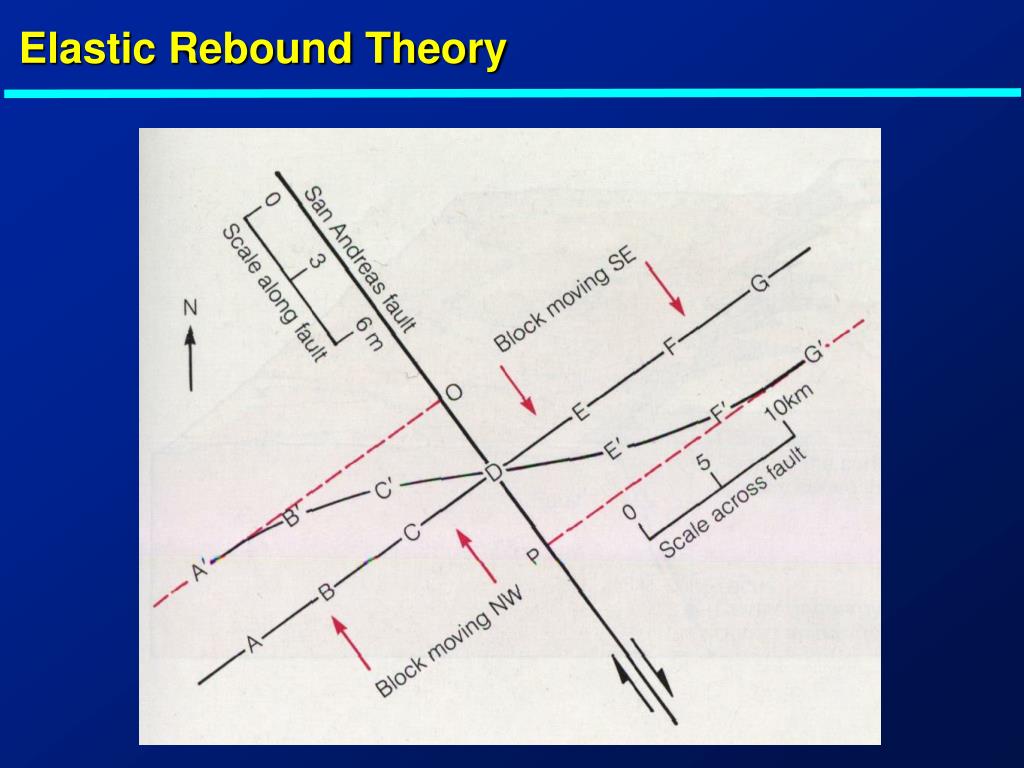
As to what would happen to a person on one side or the other or straddling the rupture, for sure you'd fall down. Beyond that, and barring that nothing fell on you, you didn't fall into a fissure that opened up along something like a mole track, you didn't end up sinking into a liquefaction feature, or were damaged by the eruption of something like a sand boil, I'm not sure you'd necessarily be injured. I'm not aware of any indication that seismic waves have ever induced air pressure waves to the point where they'd be physically damaging to a person for example.
[deleted] t1_j7phvpz wrote
CrustalTrudger t1_j7pgzlr wrote
Reply to comment by UnamedStreamNumber9 in Do Little Earthquakes Prevent Big Earthquakes? by cpassmore79
Yes, slow slip events, or alternatively episodic tremor and slip (ETS), and a variety of other "aseismic" processes represent long-duration versions of strain release that occur on a variety of subduction zones (Cascadia included) either completely independent of traditional seismic events or in concert (e.g., afterslip) with them. Of relevance though, they are explicitly not earthquakes in the typical definition (i.e., they are aseismic) and as the focus of the question is "do small magnitude earthquakes impact the probability of large magnitude earthquakes?", slow-slip / tremor discussions gets a bit into the weeds (so me leaving them out was a conscious choice).
If we consider equivalent magnitudes, most observed slow-slip or ETS events are still kind of in the ball park of "small events" , i.e., mid 5s to 6s, but some do release equivalent magnitudes of strain as a Mw 8+ if you "sum up" the total moment of the event over the days, weeks, months, etc. (e.g., Schwartz & Rokosky, 2007). Perhaps more importantly, the extent to which patches of subduction zones which experience these various aseismic type of slow/quiet/silent slip (1) restrict which patches fail seismically, (2) influence the balance between seismic slip vs aseismic afterslip in the patches that do fail at least in part seismically, or (3) themselves can rupture seismically given the right conditions are all very active areas of research, largely without clear answers, or at least answers that are easily generalized to all subduction zones (e.g., Rolandone et al., 2018, Mallick et al., 2021, Zhao et al., 2022, etc.). Thus, while it is reasonable to consider that slow slip and similar aseismic processes influence the style of seismic strain release, how they do so (both mechanistically but also in terms of actual event temporal and spatial statistics) is a large open question.
[deleted] t1_j7pfz37 wrote
Reply to comment by steeltowndude in Why aren't anabolic steroids/HGH prescribed for patients recovering from wounds/grafts? Wouldn't the steroids speed up recovery time? by TPMJB
[removed]
[deleted] t1_j7pep3j wrote
UnamedStreamNumber9 t1_j7pdnxl wrote
Reply to comment by CrustalTrudger in Do Little Earthquakes Prevent Big Earthquakes? by cpassmore79
While not an expert in the field, one thing that is missing in your explanation is the relationship between fault displacement and stored energy. For the cascadia fault in particular I recall reading in SciAm about “slow earthquakes” where sections of the fault slip/move over a period of hours or days instead of seconds, and in doing so dissipate some of the energy/tension stored on the fault without an intense release of energy to create a quake
Sub0ptimalPrime t1_j7qaru9 wrote
Reply to comment by Endorkend in What would happen to a person standing on the edge of a faultline when it moves? by Endorkend
It's also important to note that the energy epicenter is below ground. So the release of energy (the equivalent of the volcanic "explosion" you speak of) is actually below ground at the point of greatest elastic rebound (or friction overcome). That "explosion" has to then travel through thousands of feet of rock (depending on how deep the epicenter is, which is controlled by what kind of plate margin it is), so it is greatly dissipated.
Edit: has to travel through *miles of rock ("thousands of feet of rock" wasn't wrong, but doesn't put the reader in the right frame of magnitude)