Recent comments in /f/askscience
SgtSchabing t1_j7fiqcn wrote
Reply to Why are green and red laser pointers so cheap and available, but yellow ones not so much? by SurprisedPotato
Laser diodes are made from a semiconducting material. We have different materials available, and the choice of material determines the colour. We have good working and widely used materials available for red and blue, but not for the space inbetween (green, yellow, cyan, orange). As someone else described, it is relatively easy to produce green from infrared. For the other colours, we do not have materials available for home consumer use. There are some, but they are not in high demand which is why they are not as cheap and widely available.
contractor_inquiries t1_j7fidzp wrote
Reply to comment by AllenRBrady in Is the yearly cycle of varying daylight durations from day to day throughout time consistent? Is the cycle we have today the same as in the 17th century? by meellowstar
Were hours based on position of sun, and thus all different lengths, or roughly the same amount?
Or were they just rough ideas of "chunk of time" and people didn't really think about it too much?
bionic_human t1_j7fg4kq wrote
Reply to comment by open_reading_frame in Did the 2009 H1N1 outbreak in the US increase the incidence of type 1 diabetes in adolescents? by legendary_kazoo
I would expect it to occur with any virus that causes metabolic disruption. I haven’t seen any statistical analysis on timing of new diagnoses, but many T1s report getting diagnosed around holidays, during which virus transmission (even asymptomatic) naturally spikes.
I’d imagine to even begin to get a feel for it, you’d need a huge sample size and accurate medical record coding to mine for. KP and other large health systems would be the most likely to have the necessary data, but someone would have to see enough value in the research/potential results to actually fund the analysis, even if you had access to the data.
[deleted] t1_j7ffv62 wrote
[deleted] t1_j7fer84 wrote
Reply to comment by ellipsis31 in Why are green and red laser pointers so cheap and available, but yellow ones not so much? by SurprisedPotato
[removed]
[deleted] t1_j7fefpa wrote
Reply to comment by Stinky_Flower in Do tonal language speakers understand each other while whispering? by Paulix_05
[removed]
zerpa t1_j7fe0eo wrote
Reply to comment by abeinszweidrei in Why are green and red laser pointers so cheap and available, but yellow ones not so much? by SurprisedPotato
And why can't you just mix red and green, just like we do on a monitor/TV? The eye does not require a specific wavelength to perceive yellow.
_GD5_ t1_j7fdzu1 wrote
Reply to Why are green and red laser pointers so cheap and available, but yellow ones not so much? by SurprisedPotato
Cyan and yellow solid state lasers exist. They are not common or cheap though.
Red and blue lasers technology was driven by the CD and DVD industries. A lot was invested to make them fast and cheap. Green was pushed later to make RGB displays and because humans are very sensitive to that color. Green pointers are perceived as very bright. There hasn’t been much invested in yellow or cyan.
Cyber_Fetus t1_j7fdg54 wrote
Reply to comment by KBoxter in Do tonal language speakers understand each other while whispering? by Paulix_05
Cot-caught merger. It covers a good chunk of the US and Canada, so I wouldn’t exactly call it a “weird way of speaking”. But regardless, it was just an example so if you pronounce them differently I’d hope you can manage to come up with two different words that are pronounced the same in your accent.
KBoxter t1_j7fcpne wrote
Reply to comment by Cyber_Fetus in Do tonal language speakers understand each other while whispering? by Paulix_05
you have a really weird way of speaking if "bought" and "bot" are the same word
[deleted] t1_j7fcft1 wrote
Reply to Why oil fries, while water boils? by SaboKunn
[removed]
princeofgonville t1_j7fbdof wrote
Reply to comment by ECatPlay in Understanding that deuterium and tritium are simply isotopes of hydrogen, is there an equivalent periodic table that shows all known elements and their isotopes? by [deleted]
(a) this is fascinating and will distract me all day from what I was supposed two be doing.
(b) how come I didn't learn about this at school? (I did both chemistry and physics - was I not paying attention?)
abeinszweidrei t1_j7fb7xr wrote
Reply to comment by Stinky_Flower in Do tonal language speakers understand each other while whispering? by Paulix_05
The vocal sound is much longer in bought than in bot. At least the way I speak and hear it usually Edit: also the t is harder in bot
[deleted] t1_j7fappj wrote
abeinszweidrei t1_j7fajh1 wrote
Reply to comment by ellipsis31 in Why are green and red laser pointers so cheap and available, but yellow ones not so much? by SurprisedPotato
This, but I think there's even more to it: When checking a plot of wavelengths vs color, (eg https://www.gentec-eo.com/media/3583/commercial_laser_lines.png ) one can see that the region of wavelengths perceived as yellow or cyan is rather narrow compared to red, green, or blue. So if you want a yellow laser, you need a laser running pretty exactly at the desired wavelength, so when frequency doubling around 1140-1180 nm. It is doable, but red or green is just much easier as its a wider range (and suitable lasers have been lon established, e.g. Nd:YAG at 1064nm to be frequency doubled to 532nm, which is a great green).
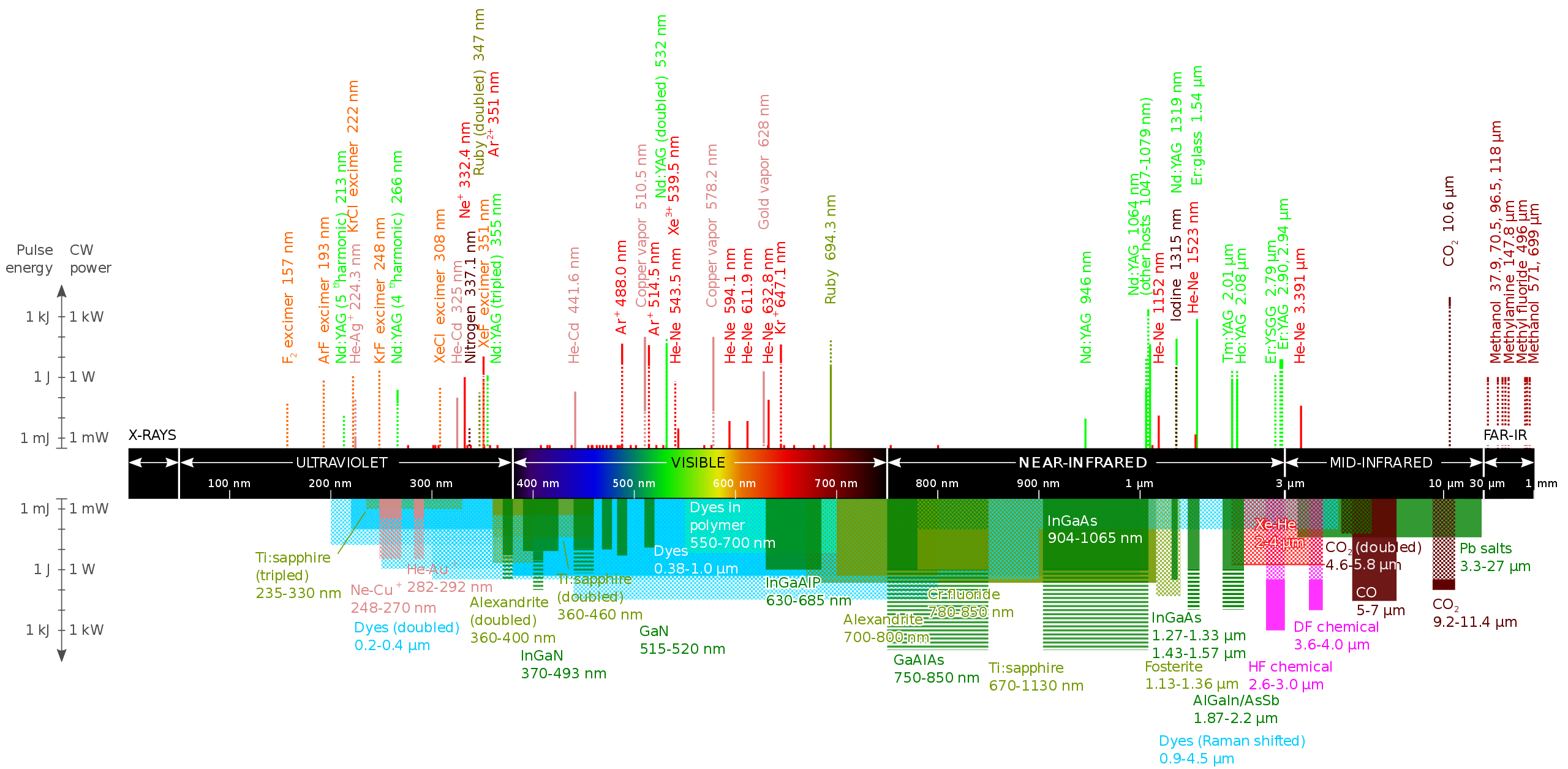
And I think another point comes into play: yellow is just really not convenient as a laser pointer, when most slides have a bright background. Red and especially green can just be seen mich easier also with low power.
So I think in the end it's a combination of harder/more expensive to engineer and just little demand for it.
CrustalTrudger t1_j7f927z wrote
Reply to comment by bullwinkle8088 in Is there a term for lake bottoms that "hour glass" (temporarily becomes wider following a "shelf" as the depth increases ) , how do bathymetric maps depict this, and does this have a common affect on turbidity, thermoclines, or other characters? by Irisgrower2
Right, I understand what an hourglass looks like, the point is that this type of question probably stemmed from a particular example and so providing that example would help narrow down specifically what OP is asking about.
[deleted] t1_j7f91ni wrote
Reply to comment by Stinky_Flower in Do tonal language speakers understand each other while whispering? by Paulix_05
[removed]
Stinky_Flower t1_j7f8zo3 wrote
Reply to comment by PepszczyKohler in Do tonal language speakers understand each other while whispering? by Paulix_05
I bought a twitter bot. Where are they pronounced differently?
[deleted] t1_j7f8eld wrote
Reply to comment by ellipsis31 in Why are green and red laser pointers so cheap and available, but yellow ones not so much? by SurprisedPotato
[removed]
SolasHealth t1_j7f7jnb wrote
Reply to When does the body store fat? by fappie6
That's a good question. Your idea is also admirable. However, the fact is not as you assumed. When you consume fat, it is stored in your cells. These cells stores energy in the form of glycerides.. Later, these glycerides degraded and released energy when required. When the number of fat storage cells increases , a person gains weight. This is an ongoing process. Storing fat is not going to happen overnight.
[deleted] t1_j7f6z7o wrote
Reply to comment by OrbitalPete in Why oil fries, while water boils? by SaboKunn
[removed]
[deleted] t1_j7f6sxt wrote
Reply to comment by PepszczyKohler in Do tonal language speakers understand each other while whispering? by Paulix_05
[removed]
abeinszweidrei t1_j7fjtda wrote
Reply to comment by zerpa in Why are green and red laser pointers so cheap and available, but yellow ones not so much? by SurprisedPotato
Good question, I don't know. Sounds like it could work. A quick search only gave me some single wavelength yellow ones though. My guess is that they are just more expensive. You'll need two lasers, and also optics compensated for the chromatic shift and suitably coated. That's straightforward, but probably just makes it too expensive for normal laser pointers. But yeah, i don't see a fundamental reason not to make it like this