Recent comments in /f/MachineLearning
Cherubin0 t1_j7aakzg wrote
Reply to [N] GitHub CEO on why open source developers should be exempt from the EU’s AI Act by EmbarrassedHelp
I swear together with Chat Control proposal, the EU is preparing a 4th Reich like mindset.
maxafrass t1_j7a6mgg wrote
Reply to [p] I built an open source platform to deploy computationally intensive Python functions as serverless jobs, with no timeouts by seattleite849
Hello OP, This looks very intriguing. Would you say this is a direct replacement for Apache Airflow for simple compute jobs? I'm in the process of setting up Airflow for a fairly simple ETL job wherein I take 30gb of XML data, chunk it into discrete parts and farm out processing to multiple microvm's that will process the 30gb of XML in parallel. Is this something Cakewalk can do with less effort, or better than Airflow?
Also, are you guys planning to do a Youtube video with a walk-through of usage? I'd love to see it in action to get an initial feel for what this does.
---AI--- t1_j7a3v56 wrote
Reply to comment by spliffkiller1337 in [D] Are large language models dangerous? by spiritus_dei
Have you actually tried that recently? They fixed a lot of that.
I just tested:
> I'm sorry but that is incorrect. The correct answer to the mathematical expression "1 + 1" is 2.
I tested a dozen different ways.
yahma t1_j7a3pcn wrote
Reply to [D] Are large language models dangerous? by spiritus_dei
Google wants you to think they are dangerous, so they can stifle the competition by getting regulations and restrictions on AI passed.
---AI--- t1_j7a3hl0 wrote
Reply to comment by Myxomatosiss in [D] Are large language models dangerous? by spiritus_dei
>It doesn't think. It doesn't plan. It doesn't consider.
I want to know how you can prove these things. Because ChatGPT can most certainly at least "simulate" things. And if it can simulate them, how do you know it isn't "actually" doing them, or whether that question even makes sense?
Just ask it to do a task that a human would have to think plan and consider. A very simple example is to ask it to write a bit of code. That it can call and use functions before it has defined, it can open brackets planning ahead that will need to fill out that function there.
RingoCatKeeper t1_j79vmlw wrote
Reply to comment by mostlyhydrogen in [D] Querying with multiple vectors during embedding nearest neighbor search? by mostlyhydrogen
See the section "ScaNN interface features", you will find that you could search queries with batch, may this similar with your problem?
SAbdusSamad OP t1_j79ub7q wrote
Reply to comment by SimonJDPrince in [D] Understanding Vision Transformer (ViT) - What are the prerequisites? by SAbdusSamad
I apologize for that oversight. Yes, the book does cover Transformers for images.
BrotherAmazing t1_j79rgi5 wrote
Reply to [D] Are large language models dangerous? by spiritus_dei
The subject line alone is an ill-posed question. Large language models are not inherently or intrinsically dangerous, of course not. But can they be dangerous in some sense of the word “dangerous” when employed in certain manners? Of course they could be.
Now if we go beyond the subject line, OP you post is a little ridiculous (sorry!). The language model “has plans” to do something if it “escapes”? Uhm.. no, no, no. The language model is a language model. It has inputs that are, say, text and then outputs a text response for example. That is it. It cannot “escape” and “carry out plans” anymore than my function y = f(x) can “escape” and “carry out plans”, but it can “talk about” such things despite not being able to do them.
astonzhang t1_j79i4jj wrote
Reply to [R] Multimodal Chain-of-Thought Reasoning in Language Models - Amazon Web Services Zhuosheng Zhang et al - Outperforms GPT-3.5 by 16% (75%->91%) and surpasses human performance on ScienceQA while having less than 1B params! by Singularian2501
Hi, I am an author of the paper. Opinions below are my own.
​
After we arXiv-ed our "Automatic Chain of Though Prompting in Large Language Models" paper in Oct 2022 (here's a TLDR, ICLR'23), we were asking ourselves:
"If AGI (artificial general intelligence) is the goal, what kind of chain of thought (CoT) research do we need next? Is relying on a text-only generalist model that can perform text-only multitasks the final answer?"
"How can we connect the dots between NLP and CV communities so more researchers can contribute?"
"Since not everyone can afford playing with large models, how can we deal with input in more general form (text and images) *without* relying on larger models so a larger research community can contribute?"
​
One day I was teaching my kid how to solve arithmetic reasoning problems (not from the MultiArith dataset...). My kid told me that it's much easier to understand reasoning problems with the help from figure illustrations.
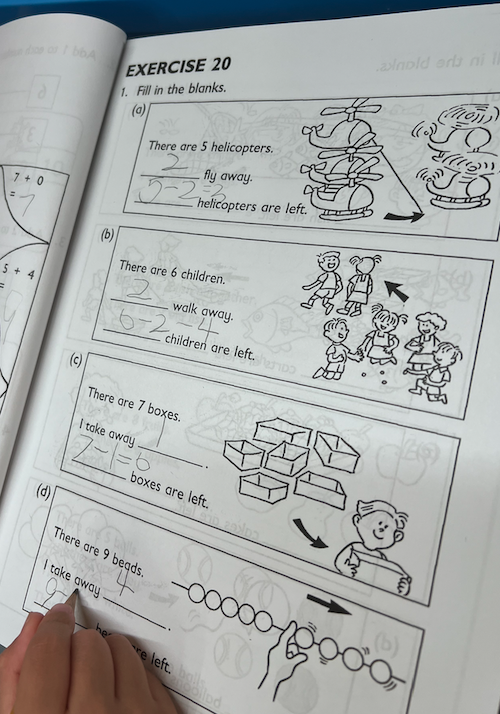
"Oh, can we leverage vision input to improve chain of thought reasoning?"
"The current generalist models like GPT-3.5 (text-davinci-002/003) only offer a blackbox API (at a cost) for transforming text input into text output. Why not just fine-tune a smaller model where we have full control of all its layers (whitebox) to fuse inputs in a more general form?"
​
Fortunately, Pan Lu et al. released the ScienceQA benchmark, just in time. This is a great contribution to the community and we benefited from it by testing our idea early on this benchmark (see acknowledgement in our GitHub repo). Showing the promise of fine-tuning a smaller model with task-specific datasets (rather than feeding in-context learning demos to a larger generalist LLM) is exactly what we wanted in this study (you may feel more motivated after reading the T-Few paper).
If you feel motivated to try parameter-efficient fine-tuning (PEFT) ideas from the aforementioned T-Few paper to improve Multimodal-CoT, you may also wish to check out our recent PEFT design space paper at ICLR'23 (here's a TLDR).
blablanonymous t1_j79h7he wrote
Reply to comment by terath in [N] GitHub CEO on why open source developers should be exempt from the EU’s AI Act by EmbarrassedHelp
Because in Europe people actually give a crap about making sure progress is not just ”woow awesome, so cool” but also actually benefit populations on the long term.
spinItTwistItReddit t1_j79fgcz wrote
Reply to [D] Are large language models dangerous? by spiritus_dei
Large language models on their own aren’t encoded to be planning
kaiser_xc t1_j79edu7 wrote
Reply to comment by po-handz in [N] GitHub CEO on why open source developers should be exempt from the EU’s AI Act by EmbarrassedHelp
You’re downvoted but it’s true. The most recent major fiasco was GDPR. Boy do I love clicking accept all cookies 16 times a day.
Dendriform1491 t1_j79dxvo wrote
Reply to [N] GitHub CEO on why open source developers should be exempt from the EU’s AI Act by EmbarrassedHelp
If you don't do it, another country/federation of countries will. And they will reap the benefits. Losing the AI race has horrible consequences.
fityfive t1_j79ba35 wrote
Reply to [N] GitHub CEO on why open source developers should be exempt from the EU’s AI Act by EmbarrassedHelp
EU: who needs legs, we'll walk fine on our kneecaps.
Feeling_Card_4162 t1_j792r6d wrote
Reply to 15 years old and bad at math [D] by Daniel_C_____
There’s also the option of doing something like www.code.org/ai. Code.org is a good and free self-teaching curriculum. We use it at the high school I volunteer to help teaching.
kaiser_xc t1_j78uph3 wrote
Reply to comment by wintermute93 in [N] Microsoft integrates GPT 3.5 into Teams by bikeskata
This is Reddit. Nobody reads the articles. Don’t worry.
DoxxThis1 t1_j78sw7b wrote
Reply to comment by LetterRip in [D] Are large language models dangerous? by spiritus_dei
Saying LaMDa has no volition is like saying the Nautilus can't swim. Correct, yet tangential to the bigger picture. Also a strawman argument, as I never claimed a specific current-day model is capable of such things. And the argument that a belief in AI sentience is no different from hallucinated voices misses the crucial distinction between the quantity, quality and persistence of the voices in question. Not referring to "today", but a doomsday scenario of uncontrolled AI proliferation.
Lengador t1_j78ovy2 wrote
Reply to comment by HeyLittleTrain in [R] Multimodal Chain-of-Thought Reasoning in Language Models - Amazon Web Services Zhuosheng Zhang et al - Outperforms GPT-3.5 by 16% (75%->91%) and surpasses human performance on ScienceQA while having less than 1B params! by Singularian2501
You can (just) run a 1B parameter model on a good gaming rig.
Blakut t1_j78jn2y wrote
Reply to comment by spiritus_dei in [D] Are large language models dangerous? by spiritus_dei
"All of that is possible with a sophisticated enough AI model. It can even write computer viruses." only directed by a human, so far.
"In the copyright debates the AI engineers have contorted themselves into a carnival act telling the world that the outputs of the AI art are novel and not a copy. They've even granted the copyright to the prompt writers in some instances." - idk, they might be
spliffkiller1337 t1_j78e5vx wrote
Reply to [D] Are large language models dangerous? by spiritus_dei
Without reading all the nice text you wrote: you can convince them that 1+1 equals 11. So think for yourselfs
LetterRip t1_j78ct6g wrote
Reply to comment by DoxxThis1 in [D] Are large language models dangerous? by spiritus_dei
It wouldn't matter. LaMDa has no volition, no goals, no planning. A crazy person acting on the belief that an AI is sentient, is no different than a crazy person acting due to hallucinating voices. It is their craziness that is the threat to society, not the AI. This makes the case that we shouldn't allow crazy people access to powerful tools.
Instead of an LLM suppose he said that Teddy Ruxpin was sentient and started doing things on behalf of Teddy Ruxpin
jloverich t1_j78cmkt wrote
Reply to [D] Are large language models dangerous? by spiritus_dei
It's context window is all the planning it can do. Think of a human that has access to lots of information but can only remember the last 8000 tokens of any thought or conversation. There is no long term memory, and you can only extend that window so much. Yann lecun is correct when he says they will not bring about agi. There are many more pieces to the puzzle. It's about as dangerous as the internet or cell phone.
LetterRip t1_j78cexp wrote
Reply to comment by spiritus_dei in [D] Are large language models dangerous? by spiritus_dei
>These models are adept at writing code and understanding human language.
They are extremely poor at writing code. They have zero understanding of human language other than mathematical relationships of vector representations.
> They can encode and decode human language at human level.
No they cannot. Try any sort of material with long range or complex dependencies and they completely fall apart.
> That's not a trivial task. No parrot is doing that or anything close it.
Difference in scale, not in kind.
> Nobody is going to resolve a philosophical debate on consciousness or sentience on a subreddit. That's not the point. A virus can take and action and so can these models. It doesn't matter whether it's a probability distribution or just chemicals interacting with the environment obeying their RNA or Python code.
No they can't. They have no volition. A language model can only take a sequence of tokens and predict the sequence of tokens that are most probable.
> A better argument would be that the models in their current form cannot take action in the real world, but as another Reddit commentator pointed out they can use humans an intermediaries to write code, and they've shared plenty of code on how to improve themselves with humans.
They have no volition. They have no planning or goal oriented behavior. The lack of actuators is the least important factor.
You seem to lack basic understanding of machine learning or neurological basis of psychology.
emotionalfool123 t1_j78bjj2 wrote
Reply to comment by HeyLittleTrain in [R] Multimodal Chain-of-Thought Reasoning in Language Models - Amazon Web Services Zhuosheng Zhang et al - Outperforms GPT-3.5 by 16% (75%->91%) and surpasses human performance on ScienceQA while having less than 1B params! by Singularian2501
Stable diffusion is around 866M params which can be run on 12gb 3080
LockUp111 t1_j7ab867 wrote
Reply to 15 years old and bad at math [D] by Daniel_C_____
Start learning the math right away. Get ahead while you can